


The Data (Use and Access) Act 2025 introduced a series of changes to UK data protection law, with all its data protection provisions in force by 19 June 2026.
The changes do not replace UK GDPR and, for most small businesses, they don’t require a complete overhaul of existing processes.
Instead, the changes are intended to simplify certain areas of data protection law, support responsible innovation and make some requirements clearer.
For many businesses, this is less about starting again and more about taking the opportunity to review existing policies, procedures and business systems to ensure they remain fit for purpose.
If your business already handles personal information responsibly and has good organisational processes in place, you’re likely to be in a strong position.

This guide has been written for:
✓ Small business owners
✓ Sole traders
✓ Limited company directors
✓ Start-ups
✓ Office managers
✓ Virtual assistants
✓ Anyone responsible for handling customer or employee information within a small business.
It is not intended to replace legal advice or provide an exhaustive interpretation of legislation.
Instead, it translates the official guidance into practical, everyday business language.
By the end of this guide, you’ll understand:
• What has changed under the Data (Use and Access) Act 2025.
• How the new legislation relates to UK GDPR.
• Whether the changes affect your business.
• The practical steps you should consider taking.
• How organised business systems make future compliance much easier.
• Where to find further official guidance if you need it.
New legislation can make it feel as though everything needs to change at once.
Usually, that isn’t the case.
This guide is here to help you understand what has changed, what it means for your business and what, if anything, you need to do next.
We’ll keep things practical, use plain English and point you towards official guidance where it matters.
The aim is simple: to help you feel informed, reassured and clear about your next steps.

The short answer: probably not.
For most UK small businesses, this is more of a check-up than a complete reset.
UK GDPR still applies, and if you already handle personal information responsibly, you’re likely to have good foundations in place.
The important thing is not to react to headlines or start changing everything. First, understand what has changed, whether it affects your business and whether anything you already have simply needs updating.
Before changing anything:
When your information, documents and processes are organised, changes like this become much easier to deal with.
You know what you already have, where to find it and what actually needs updating, rather than feeling like you have to start from scratch.
That’s exactly the kind of thing good business systems should do: make running your business feel simpler, not harder.
The Data (Use and Access) Act 2025 updates parts of the UK’s existing data protection rules rather than replacing them.
For most small businesses, the biggest thing to understand is that the familiar principles of UK GDPR are still in place. The changes are more about updating, clarifying and improving certain areas than introducing a completely new system.
Since 19 June 2026, businesses have been legally required to have a process for handling data protection complaints.
Complaints must be acknowledged within 30 days, investigated without undue delay and the person kept informed.
If you already have a customer complaints process, you may simply need to adapt it to cover data protection concerns.
When someone asks for a copy of their personal information, this is known as a subject access request (SAR).
The legislation clarifies that businesses only need to carry out reasonable and proportionate searches when responding to these requests.
People still have the right to access their personal information, so knowing where your business stores that information remains important.
Some website cookies can now be used without asking visitors for consent, including certain cookies used to understand how a website is performing or improve its functionality.
There are still conditions to meet, and advertising cookies continue to require consent.
If your business has a website, it’s worth checking which cookies you use and whether your cookie settings and information remain appropriate.
The new legislation gives businesses more flexibility to make significant decisions about people using automated systems without human involvement.
However, people must still be able to challenge those decisions and request human involvement. Stricter rules apply when using sensitive personal information.
If you use automated tools to make decisions about customers or employees, this is an area worth reviewing.
You do not need to memorise every legislative amendment.
For most small businesses, the important thing is making sure your existing systems still reflect how your business actually works today
This is just as important.
You still need to:

Because the way businesses use data has changed too.
Cloud software, online services, digital tools and AI are now part of everyday business life.
The Data (Use and Access) Act 2025 updates parts of the UK’s data protection framework to reflect that changing environment, while keeping the core protections of UK GDPR in place.
The legislation is intended to:
• modernise parts of the existing data protection framework
• make some requirements clearer
• support responsible innovation
• improve the use of data where there is a clear public benefit
• maintain strong protections for personal information
It does not mean businesses have suddenly been doing everything wrong.
For most small businesses, the important thing is simply to make sure your policies, processes and systems still reflect the way you work today.
If you’ve introduced new software, cloud tools or AI since you last reviewed your data protection arrangements, that is a good reason to check that your documentation is still accurate.
You cannot predict every new piece of legislation or technology.
But if you know what information you hold, where it is stored and how your processes work, you are much better placed to adapt when things change.
Probably, because most businesses handle some form of personal information.
That might include:
• customer names and contact details
• employee records
• supplier information
• website enquiries
• email marketing lists
• CRM data
• online bookings or orders
• CCTV
• cloud-based systems
• AI tools that process personal information
For most small businesses, the focus should be on knowing what personal information you hold, why you need it and how it is looked after.

A sole trader may only hold a small amount of customer information.
An employer may also need to think about recruitment, payroll and staff records.
A business running email marketing may need to review how contact details are collected and used.
A business using cloud systems or AI tools may need to check where information is stored and which suppliers are involved.
The important thing is to focus on the parts that are relevant to the way your business actually works.
Have a look at the statements below and see which ones already feel true for your business:
• We know what personal information we collect.
• We know why we collect it.
• We know where it is stored.
• We know who has access to it.
• Our privacy notice still reflects how we work.
• We know what to do if someone raises a data protection concern.
• We have reviewed any new software or AI tools we now use.
• We know who would deal with a data protection enquiry.
It is about having processes that match the way your business actually works.
Clear documents matter, but they should support good practice, not replace it.
What should I do now?
Start with what you already have.
You do not need to rewrite everything or introduce a whole new compliance system.
For most small businesses, the best next step is to review what is already in place and check that it still reflects how the business works today.
Check that it still accurately explains:
• what personal information you collect
• why you collect it
• how it is used
• which systems or suppliers are involved
• how people can contact you about their data
If something has changed since it was last updated, make a note.
Policies are only useful if they match what actually happens.
Think about:
• where customer information is sto• red
• who can access it
• how staff handle it
• how you would locate and provide someone’s personal information if they requested it
• what happens if someone raises a concern
If these details only exist in someone’s head, it may be worth writing them down.
Knowing where personal information is stored also makes it easier to carry out reasonable and proportionate searches when responding to subject access requests.
Have you introduced anything new since your last review?
That could include:
• AI tools
• CRM software
• cloud storage
• booking systems
• email marketing platforms
• payroll or HR software
• digital forms
• collaboration tools
If you have, check that your Privacy Notice and internal processes still reflect how those tools are being used.
There are also two areas worth checking following the 2026 changes:
• If your business has a website, review your cookies and consent settings.
• If you use automated systems to make significant decisions about people without human involvement, check that the appropriate safeguards are in place.
Only focus on the areas that are relevant to your business.
You don’t need a complicated complaints process, but you do need to make sure it meets the new requirements.
Check that your business has a clear way to:
• receive and record complaints
• acknowledge them within 30 days
• investigate them without undue delay
• keep the person informed
• communicate and record the outcome
If you already have a customer complaints process, start by checking whether it can be adapted.
Data protection is much easier to manage when it is reviewed regularly rather than left until something changes.
A simple annual review can help keep your documents, systems and processes up to date.
You do not need to fix everything in one go.
Focus on the areas most relevant to your business and make sensible updates as you go.
Small, regular improvements are much easier to manage than a big catch-up later.
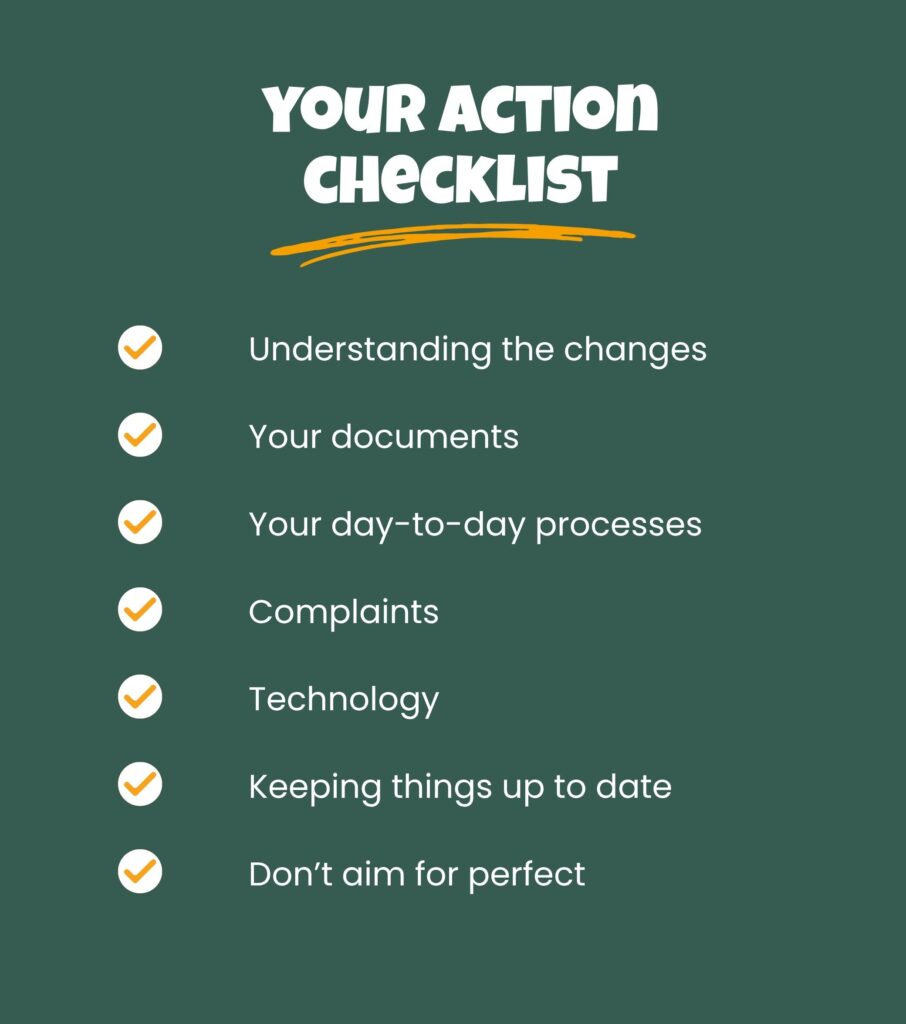
A quick check to make sure you’ve covered the essentials.
You do not need to complete everything at once.
Work through the list at a pace that suits your business and use it to spot anything that still needs your attention.
Understanding the changes
☐ We understand the main changes that are relevant to my business.
☐ We know where to find official guidance if I need it.
Your documents
☐ We’ve reviewed our Privacy Notice.
☐ We’ve checked that our data protection information still reflects how the business works today.
☐ Our contact details are up to date.
☐ We know what personal information we hold.
☐ We know why we hold it.
☐ We know where it is stored.
☐ We know who can access it. ☐ We know how long we need to keep personal information.
☐ We know how to locate and provide personal information if someone makes a subject access request.
☐ People have a clear way to raise data protection complaints with us.
☐ We know who is responsible for handling complaints.
☐ We can acknowledge complaints within 30 days.
☐ We have a process for investigating complaints, keeping people informed and communicating the outcome without undue delay.
☐ We’ve reviewed any newer software, cloud systems or AI tools.
☐ We’ve checked whether our documents and processes still reflect how those tools are being used.
☐ We’ve reviewed our website cookies and consent settings, where applicable.
☐ We’ve checked that appropriate safeguards are in place if we use automated systems to make significant decisions about people.
☐ We know who is responsible for keeping this information current.
☐ We have a review date in the diary.
If you can’t tick every box today, that’s fine.
The point of this checklist is not to create more pressure. It is to give you a clear view of what is already in place and what might need attention next.
One small improvement at a time is still progress.
Quick answers to some of the questions small business owners are most likely to have.
No.
UK GDPR still applies. The Data (Use and Access) Act 2025 updates parts of the existing data protection framework rather than replacing it.
Probably not.
The best place to start is by checking whether your current Privacy Notice still accurately reflects how your business collects, uses and stores personal information.
If your systems, software or ways of working have changed, some updates may be needed.
Yes.
If you handle personal information, even something as simple as customer names, email addresses or appointment details, data protection law still applies.
Your responsibilities may be simpler than those of a larger organisation, but they still matter.
Not necessarily.
Many small businesses will be able to understand the practical impact of the changes by using official guidance and reviewing their existing processes.
If your business handles particularly sensitive information, operates in a heavily regulated sector or has a more complex situation, professional legal advice may be appropriate.
A data protection complaint is when someone raises a concern about how your business has handled their personal information.
Since 19 June 2026, businesses have been required to provide a clear way for people to raise these complaints.
You must acknowledge the complaint within 30 days, investigate it appropriately, keep the person informed and communicate the outcome without undue delay.
The 30-day deadline is for acknowledging the complaint, not resolving it.
It is still worth carrying out a review.
If your documents and processes are already up to date, you may find there is very little to change.
The purpose is to check that everything still reflects the way your business works today.
Using AI tools does not remove your existing data protection responsibilities.
If an AI tool processes personal information, you still need to understand what information is being used, how it is handled and whether your documentation accurately reflects that use.
The new legislation also changes the rules around significant decisions made entirely by automated systems, such as automatically rejecting a job application.
If your business uses this type of technology, you must have a valid lawful basis and appropriate safeguards in place, including allowing people to challenge decisions and request human involvement.
Stricter rules apply when sensitive personal information is involved.
That depends on the cookies your website uses.
The new legislation allows certain cookies to be used without consent, provided specific conditions are met. These can include some cookies used to measure website performance or remember visitor preferences.
Visitors must still receive clear information and, where these new exceptions apply, have an easy way to object free of charge. Advertising cookies continue to require consent.
Before removing or changing your cookie banner, check which cookies your website uses and whether they qualify for an exception.
People still have the right to request access to their personal information.
The legislation clarifies that businesses must carry out reasonable and proportionate searches when responding to these requests.
You still need to make a genuine effort to locate the relevant information and will normally need to respond within one calendar month.
Keeping your records organised makes responding to these requests much easier.
An annual review is a sensible starting point.
You should also review things when there is a significant change to your business, for example, if you introduce new software, start using AI tools, change how you collect customer information or add new services.
The Information Commissioner’s Office (ICO) is the best place to start.
It provides official guidance on UK data protection law, practical information for organisations and updates when rules or guidance change.
Start with what you already have.
Use the checklist in this guide to identify any areas that need a closer look.
If you are still unsure after that, seek advice that is appropriate to your particular circumstances.
When your information, documents and processes are clear and up to date, responding to new legislation becomes much more manageable.
You know:
• what information you hold
• where it is stored
• who is responsible for it
• which documents support your processes
• what needs reviewing when something changes
That means less time searching, less uncertainty and less chance of everything becoming a last-minute job.

The same systems that make data protection easier can also make the rest of your business run more smoothly.
Clear processes can help with:
• training new team members
• delegating tasks
• keeping information consistent
• improving customer service
• reducing reliance on knowledge held by one person
• adapting when your business grows or changes
No small business has everything perfectly organised all of the time.
Processes change. Documents become outdated. New tools are introduced.
What matters is having a habit of reviewing and improving the way your business works.
Small, consistent improvements can make your business easier to run and better prepared for whatever comes next.
Finding the time to review documents, organise information and put better processes in place isn’t always easy when you’re running a business.
At The Wilkinson VA, we provide flexible admin and business support to help you get organised, keep things up to date and make your working week a little easier.
Want to explore the changes in more detail? Start with trusted sources.
The ICO is the UK’s independent authority for data protection and information rights.
It publishes practical guidance for organisations, updates on changes to data protection law and information on UK GDPR.
Useful for:
• official data protection guidance
• understanding your responsibilities
• keeping up with regulatory updates
The official legislation website is the authoritative source for Acts of Parliament and related legislation.
Use it if you want to read the Data (Use and Access) Act 2025 itself or check formal legislative updates.
Read the Data (Use and Access) Act 2025
Good data protection also depends on good cyber security.
The NCSC provides practical guidance for small businesses on areas such as passwords, phishing, multi-factor authentication and protecting business systems.
Explore small business cyber security guidance
Practical guides, resources and tools for UK small businesses.
This guide is part of Better Working, a growing collection of practical resources from The Wilkinson VA, designed to help small businesses stay organised, work more effectively and respond to change with confidence.
Explore related guidance on:
• business organisation
• systems and processes
• productivity
• digital tools and AI
• delegation and outsourcing
• compliance and change
You do not need to know everything at once.
Use trusted guidance, review what you already have and deal with the areas that are genuinely relevant to your business.
Good organisation makes change easier to manage.