


The UK’s new data protection legislation does not replace UK GDPR and, for most small businesses, it doesn’t require a complete overhaul of existing processes.
Instead, the changes are intended to simplify certain areas of data protection law, support responsible innovation and make some requirements clearer.
For many businesses, this is less about starting again and more about taking the opportunity to review existing policies, procedures and business systems to ensure they remain fit for purpose.
If your business already handles personal information responsibly and has good organisational processes in place, you’re likely to be in a strong position.

This guide has been written for:
✓ Small business owners
✓ Sole traders
✓ Limited company directors
✓ Start-ups
✓ Office managers
✓ Virtual assistants
✓ Anyone responsible for handling customer or employee information within a small business.
It is not intended to replace legal advice or provide an exhaustive interpretation of legislation.
Instead, it translates the official guidance into practical, everyday business language.
By the end of this guide, you’ll understand:
• What has changed under the Data (Use and Access) Act 2025.
• How the new legislation relates to UK GDPR.
• Whether the changes affect your business.
• The practical steps you should consider taking.
• How organised business systems make future compliance much easier.
• Where to find further official guidance if you need it.
New legislation can make it feel as though everything needs to change at once.
Usually, that isn’t the case.
This guide is here to help you understand what has changed, what it means for your business and what, if anything, you need to do next.
We’ll keep things practical, use plain English and point you towards official guidance where it matters.
The aim is simple: to help you feel informed, reassured and clear about your next steps.

Where relevant, we’ll distinguish between:
• Official Guidance – what the legislation or the Information Commissioner’s Office (ICO) says.
• Practical Interpretation – what those changes are likely to mean for a typical UK small business.
• Better Working Perspective – how organised systems and good business practices can make compliance easier, not just now but whenever legislation evolves in the future.
Our aim isn’t simply to explain the law. It’s to help you feel informed, reassured and confident about the next steps.
The short answer: probably not.
For most UK small businesses, this is more of a check-up than a complete reset.
UK GDPR still applies, and if you already handle personal information responsibly, you’re likely to have good foundations in place.
The important thing is not to react to headlines or start changing everything. First, understand what has changed, whether it affects your business and whether anything you already have simply needs updating.
Before changing anything:
When your information, documents and processes are organised, changes like this become much easier to deal with.
You know what you already have, where to find it and what actually needs updating, rather than feeling like you have to start from scratch.
That’s exactly the kind of thing good business systems should do: make running your business feel simpler, not harder.
Businesses should have a clear way for people to raise concerns about how their personal information has been handled.
For a small business, this doesn’t need to be complicated. It simply means knowing:
Some parts of the law have been updated to make them easier to understand and apply.
For many small businesses, this is unlikely to mean changing how you work day to day. It is more about giving greater clarity around certain uses of personal information.
The legislation also reflects the way businesses now use cloud systems, digital services and AI.
Using modern technology does not automatically create a problem. You still need to understand what personal information is being used, where it goes and who has access to it.
This is just as important.
You still need to:
1. use personal information lawfully and fairly
2. only collect what you genuinely need
3. keep information secure
4. keep it accurate
5. respect people’s rights
6. avoid keeping it for longer than necessary
So if you already follow good data protection practices, much of what you are doing should still feel familiar.
You do not need to memorise every legislative amendment.
For most small businesses, the important thing is making sure your existing systems still reflect how your business actually works today.

Because the way businesses use data has changed too.
Cloud software, online services, digital tools and AI are now part of everyday business life.
The Data (Use and Access) Act 2025 updates parts of the UK’s data protection framework to reflect that changing environment, while keeping the core protections of UK GDPR in place.
The legislation is intended to:
It does not mean businesses have suddenly been doing everything wrong.
For most small businesses, the important thing is simply to make sure your policies, processes and systems still reflect the way you work today.
If you’ve introduced new software, cloud tools or AI since you last reviewed your data protection arrangements, that is a good reason to check that your documentation is still accurate.
You cannot predict every new piece of legislation or technology.
But if you know what information you hold, where it is stored and how your processes work, you are much better placed to adapt when things change.
Probably. Because most businesses handle some form of personal information.
That might include:
For most small businesses, the focus should be on knowing what personal information you hold, why you need it and how it is looked after.

A sole trader may only hold a small amount of customer information.
An employer may also need to think about recruitment, payroll and staff records.
A business running email marketing may need to review how contact details are collected and used.
A business using cloud systems or AI tools may need to check where information is stored and which suppliers are involved.
The important thing is to focus on the parts that are relevant to the way your business actually works.
Have a look at the statements below and see which ones already feel true for your business:
It is about having processes that match the way your business actually works.
Clear documents matter, but they should support good practice, not replace it.
What should I do now?
Start with what you already have.
You do not need to rewrite everything or introduce a whole new compliance system.
For most small businesses, the best next step is to review what is already in place and check that it still reflects how the business works today.
Check that it still accurately explains:
If something has changed since it was last updated, make a note.
Policies are only useful if they match what actually happens.
Think about:
If the answer only exists in someone’s head, it may be worth writing it down.
Have you introduced anything new since your last review?
That could include:
If you have, check that your Privacy Notice and internal processes still reflect how those tools are being used.
You do not need a complicated process.
You simply need to know:
Data protection is much easier to manage when it is reviewed regularly rather than left until something changes.
A simple annual review can help keep your documents, systems and processes up to date.
You do not need to fix everything in one go.
Focus on the areas most relevant to your business and make sensible updates as you go.
Small, regular improvements are much easier to manage than a big catch-up later.
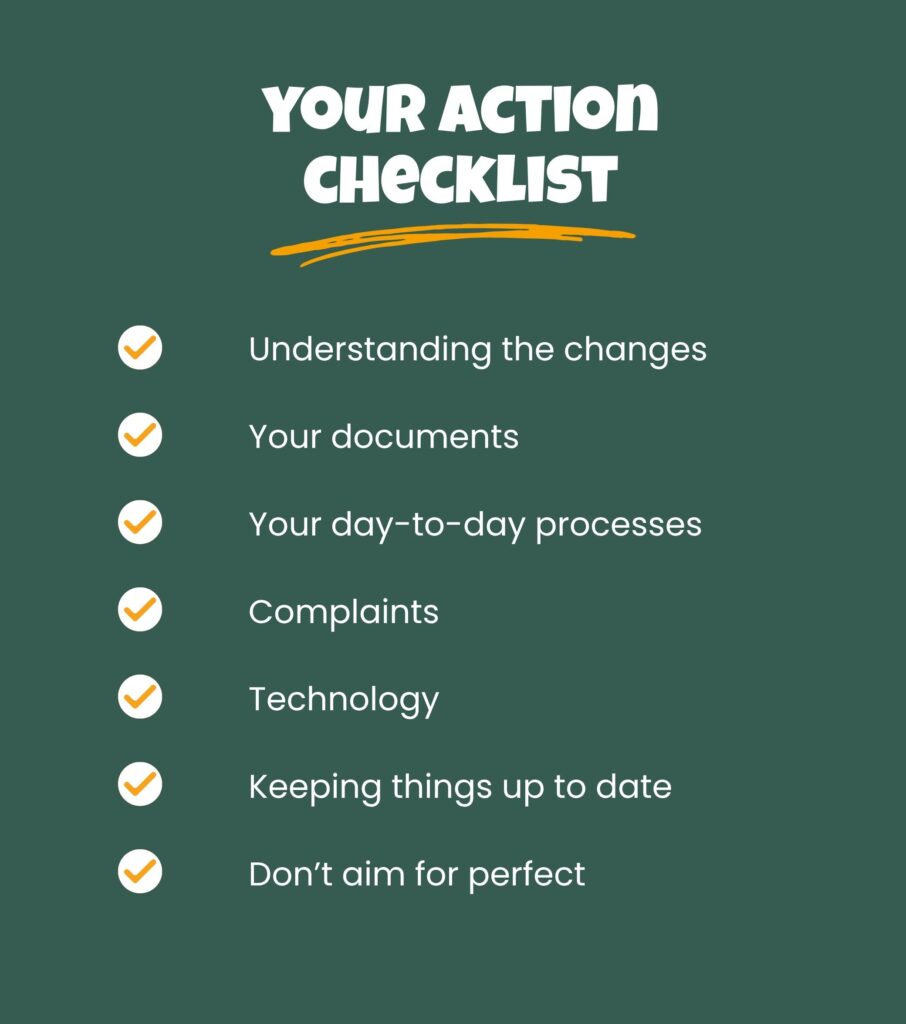
A quick check to make sure you’ve covered the essentials.
You do not need to complete everything at once.
Work through the list at a pace that suits your business and use it to spot anything that still needs your attention.
Understanding the changes
☐ I understand the main changes that are relevant to my business.
☐ I know where to find official guidance if I need it.
Your documents
☐ I’ve reviewed our Privacy Notice.
☐ I’ve checked that our data protection information still reflects how the business works today.
☐ Our contact details are up to date.
☐ We know what personal information we hold.
☐ We know why we hold it.
☐ We know where it is stored.
☐ We know who can access it.
☐ We know what to do if someone raises a data protection concern.
☐ Someone is responsible for dealing with it.
☐ We know how the complaint and outcome would be recorded.
☐ We’ve reviewed any newer software, cloud systems or AI tools.
☐ We’ve checked whether our documents and processes still reflect how those tools are being used.
☐ We know who is responsible for keeping this information current.
☐ We have a review date in the diary.
If you can’t tick every box today, that’s fine.
The point of this checklist is not to create more pressure. It is to give you a clear view of what is already in place and what might need attention next.
One small improvement at a time is still progress.
Quick answers to some of the questions small business owners are most likely to have.
No.
UK GDPR still applies. The Data (Use and Access) Act 2025 updates parts of the existing data protection framework rather than replacing it.
Probably not.
The best place to start is by checking whether your current Privacy Notice still accurately reflects how your business collects, uses and stores personal information.
If your systems, software or ways of working have changed, some updates may be needed.
Yes.
If you handle personal information, even something as simple as customer names, email addresses or appointment details, data protection law still applies.
Your responsibilities may be simpler than those of a larger organisation, but they still matter.
Not necessarily.
Many small businesses will be able to understand the practical impact of the changes by using official guidance and reviewing their existing processes.
If your business handles particularly sensitive information, operates in a heavily regulated sector or has a more complex situation, professional legal advice may be appropriate.
It is when someone raises a concern about how your business has handled their personal information.
You should have a clear way for people to raise those concerns and a simple process for recording, reviewing and responding to them.
It is still worth carrying out a review.
If your documents and processes are already up to date, you may find there is very little to change.
The purpose is to check that everything still reflects the way your business works today.
Using AI does not remove your existing data protection responsibilities.
If an AI tool processes personal information, you still need to understand what information is being used, how it is handled and whether your documentation accurately reflects that use.
A regular annual review is a sensible starting point.
You should also review things when there is a significant change to your business, for example, if you introduce new software, start using AI tools, change how you collect customer information or add new services.
The Information Commissioner’s Office (ICO) is the best place to start.
It provides official guidance on UK data protection law, practical information for organisations and updates when rules or guidance change.
Start with what you already have.
Use the checklist in this guide to identify any areas that need a closer look.
If you are still unsure after that, seek advice that is appropriate to your particular circumstances.
When your information, documents and processes are clear and up to date, responding to new legislation becomes much more manageable.
You know:
what information you hold
where it is stored
who is responsible for it
which documents support your processes
what needs reviewing when something changes
That means less time searching, less uncertainty and less chance of everything becoming a last-minute job.

The same systems that make data protection easier can also make the rest of your business run more smoothly.
Clear processes can help with:
training new team members
delegating tasks
keeping information consistent
improving customer service
reducing reliance on knowledge held by one person
adapting when your business grows or changes
No small business has everything perfectly organised all of the time.
Processes change. Documents become outdated. New tools are introduced.
What matters is having a habit of reviewing and improving the way your business works.
Small, consistent improvements can make your business easier to run and better prepared for whatever comes next.
Want to explore the changes in more detail? Start with trusted sources.
The ICO is the UK’s independent authority for data protection and information rights.
It publishes practical guidance for organisations, updates on changes to data protection law and information on UK GDPR.
Useful for:
official data protection guidance
understanding your responsibilities
keeping up with regulatory updates
The official legislation website is the authoritative source for Acts of Parliament and related legislation.
Use it if you want to read the Data (Use and Access) Act 2025 itself or check formal legislative updates.
Good data protection also depends on good cyber security.
The NCSC provides practical guidance for small businesses on areas such as passwords, phishing, multi-factor authentication and protecting business systems.
This guide is part of the Better Working Knowledge Hub, a growing collection of practical resources designed to help small businesses stay organised, work more effectively and respond to change with more confidence.
Explore related guidance on:
business organisation
systems and processes
productivity
digital tools and AI
delegation and outsourcing
compliance and change
You do not need to know everything at once.
Use trusted guidance, review what you already have and deal with the areas that are genuinely relevant to your business.
Good organisation makes change easier to manage.